
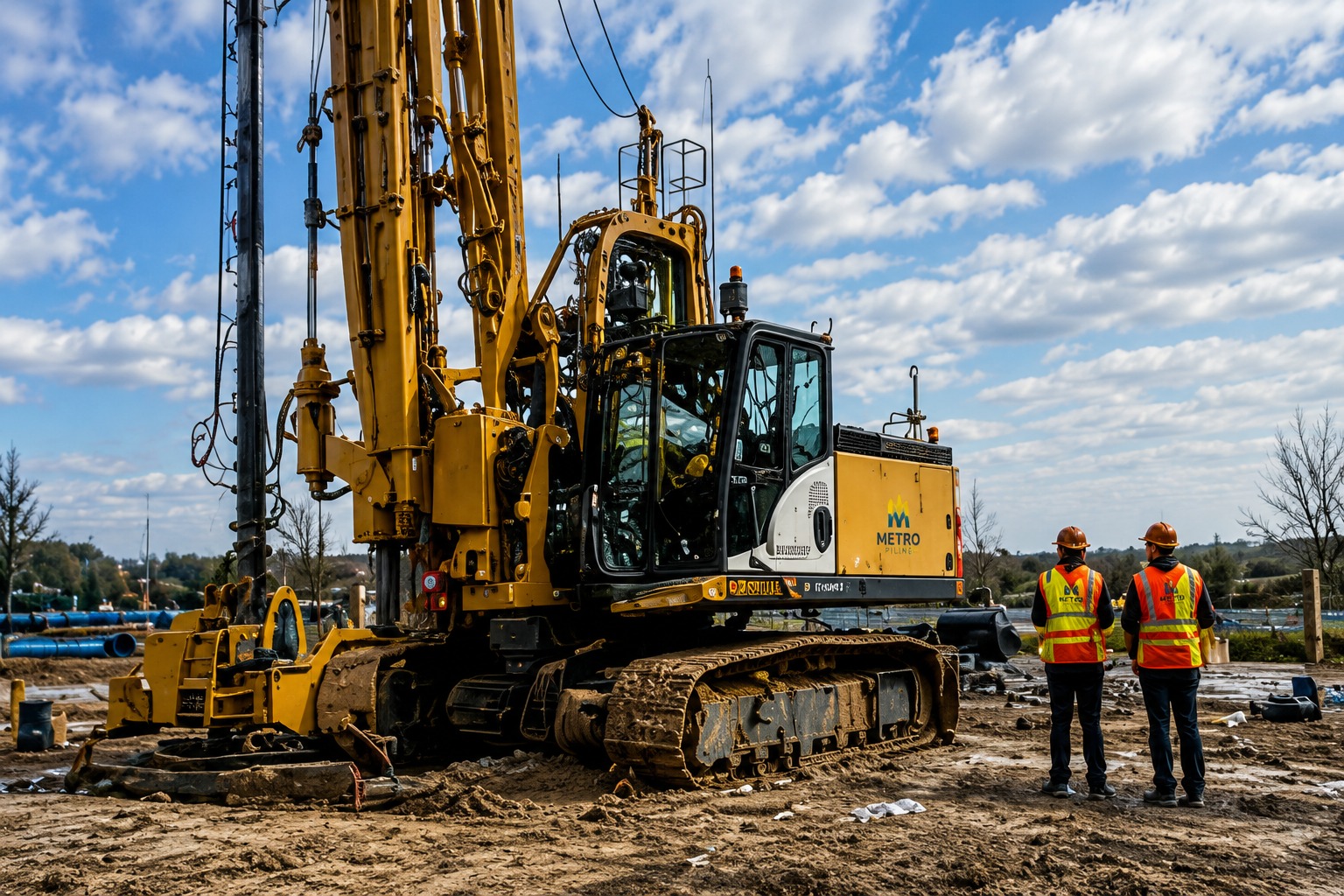
When planning a construction project, choosing the right foundation system is one of the first and most important decisions. A building’s stability and long-term durability largely depend on the ground beneath it.
In many areas, surface soils may be soft, loose, waterlogged, or highly compressible, making them unsuitable for supporting structural loads directly. In these conditions, structural piling provides a reliable deep foundation solution, transferring building and structural loads to stronger soil or rock layers deeper underground.
Structural planning can be carried out and installed using various pile types and construction techniques, depending on ground conditions, load requirements, site access, and the specific needs of the project.
What Are Piles in Construction?
A pile foundation is a deep foundation system made up of long, slender structural elements known as piles, installed deep into the ground. These piles transfer a structure’s weight to deeper soil or rock layers with enough bearing capacity to support the load.
Pile foundations may be suitable when the upper soil layer is too weak to support a building safely, when subsidence is a concern, or when groundwater conditions reduce soil strength. The main purpose of pile foundations is to transfer structural loads to more stable ground, improving overall stability and minimising the risk of long-term settlement.
How Do Piles Work?
Piling methods differ depending on the type of pile selected, but their main purpose is to distribute a building’s load effectively while providing strong structural support. Piles are typically installed using specialised pile-driving equipment, with hammering or vibration used to drive them into the ground.
The piling procedure should only begin after taking into account all relevant construction factors, particularly the composition of the underlying soil. Ground conditions determine which piling method is most appropriate for a project.
Main Types of Piles
Concrete Piles
Concrete piles are one of the most used piling materials because of their sturdiness and durability. These piles can be precast in controlled factory environments before being driven into the ground, or cast in situ by placing concrete into drilled holes on the site. While precast piles offer constant quality and strong load-bearing capacity, cast-in-situ piles provide greater flexibility for different ground conditions and can help minimise vibration.
Steel Piles
Steel piles are commonly used when projects require high load-bearing capacity and deep penetration. They are often used for heavy industrial buildings, bridges, and marine structures. In corrosive or aggressive ground conditions, appropriate protection against corrosion should be considered.
Timber Piles
Timber piles are a traditional foundation solution generally used for lighter structures. Made from long wooden sections driven into the ground, they can perform well in waterlogged environments where low oxygen levels help prevent timber decay.
Composite Piles
Composite piles are made by combining two or more materials, such as steel and concrete, to achieve specific performance benefits. For instance, steel can be used in the lower section to provide strength and improve penetration, while concrete can form the upper section for added durability.
Types of Piles Based on Installation
Driven Piles
Driven piles are pre-manufactured piles installed into the ground using specialised equipment such as hammers or vibratory drivers. They can be made from concrete, steel, or timber. Driven piling is relatively quick and works well for projects requiring high load-bearing capacity. Nevertheless, noise and vibration should be considered when installing them close to existing buildings or sensitive structures.
Bored Piles
Bored piles are created by drilling a hole into the ground and then filling it with reinforced concrete. Compared with driven piling, bored piling uses bored piles that produce less noise and vibration, making it a suitable choice for urban sites and areas near sensitive structures. These piles can support substantial loads and are adaptable to different ground conditions.
CFA Piles
CFA piles are installed using a continuous spiral auger that drills into the ground while concrete is pumped through its hollow stem as the auger is withdrawn. Reinforcement is then placed into the fresh concrete. This technique helps limit ground disturbance and is suitable for sites where noise and vibration need to be controlled. CFA piles are frequently used in urban construction.
Mini Piles
Micro and mini piles are small-diameter foundation piles designed for areas with limited access or restricted working space. They are commonly used in urban projects and for underpinning existing structures. Despite their compact size, they can provide significant additional load-bearing support when correctly designed.
Types of Piles Based on Load-Bearing
End-Bearing Piles
End-bearing piles carry structural loads down to a stronger layer of soil or rock situated deep beneath the ground surface. They act much like vertical columns, passing through weaker or compressible soil until they reach a stable stratum capable of supporting the required load. The majority of the load is transferred through the bottom tip of the pile. End-bearing piles are suitable when site investigations identify a strong supporting layer at a practical depth.
Friction Piles
Friction piles transfer structural loads through the resistance created between the outer surface of the pile shaft and the surrounding soil. Rather than depending solely on a hard layer beneath the pile, the load is distributed along its length through shaft friction. This type of pile is useful when solid rock or a strong bearing layer is located too far below the surface to reach cost-effectively.
Combined Piles
Combination piles use both end-bearing capacity and shaft friction to support and distribute structural loads. Where ground conditions change at different depths, some of the load can be transferred to a strong layer beneath the pile, while the rest is supported through friction along the pile shaft.
What Is Structural Piling?
Structural piling is a deep foundation method that involves installing long, narrow elements known as piles deep beneath the ground to transfer the weight of a heavy structure to strong bedrock or stable soil layers.
When Is Structural Piling Required?
Structural piling is necessary when the upper layers of soil lack sufficient strength to safely support a building’s weight, requiring deep foundation systems to transfer structural loads to stronger layers below ground.
- Poor or unstable ground conditions
- High or specialised structural loads
- Challenging site and environmental conditions
Factors to Consider When Choosing Piles
Selecting the best pile foundation depends on important engineering, site, and budget considerations.
Soil: Match the pile type to the ground conditions.
Loads: Consider the building’s load and size.
Water: Account for groundwater and corrosion risks.
Site: Consider space, noise, and vibration limits.
Cost: Balance material cost with durability.
Structural Piling Installation Process
The structural piling process includes site investigation, accurate setting out, pile drilling or driving, installation of steel reinforcement, and concrete placement.
Site Investigation and Preparation
Engineers assess the soil strength, bearing capacity, structural loads, and groundwater conditions; workers clear any overhead, surface, and underground obstructions. The site is then levelled and compacted to provide a stable base for heavy equipment.
Survey and Marking
Surveyors confirm site access and establish benchmark control points. The precise locations for each pile are then marked using wooden stakes, rebars, or lime powder.
Pile Installation
Large boreholes are created using rotary drilling rigs or continuous flight augers. Temporary steel casings or bentonite slurry may be used to prevent the borehole walls from collapsing. Specialised equipment is then used to drive or vibrate precast steel, timber, or concrete piles into the ground.
Reinforcement and Concreting
A steel rebar cage is placed inside the prepared borehole to provide additional tensile strength. Concrete is then pumped into the borehole from the bottom upwards, displacing any water or slurry and ensuring proper filling.
Testing and Capping
Sonic or hammer testing is carried out to identify cracks, defects, or discontinuities within the cured pile. The piles are then exposed and trimmed to the required cut-off level before a concrete pile cap is constructed over them.
Advantages of Structural Piling
High load-bearing capacity: Transfers heavy structural loads deep into the ground, reaching stronger and more stable soil or rock layers.
Suitable for difficult ground: Supports construction in weak, loose, or waterlogged soils where conventional foundations may be unsuitable.
Improved settlement control: Helps reduce uneven movement and lowers the risk of structural cracking over time.
Protection against erosion: Helps support coastal, riverside, and bridge structures exposed to soil erosion caused by moving water.
Greater uplift resistance: Provides additional stability for tall structures exposed to strong wind or earthquake-related lifting forces.
Conclusion
Pile foundations are essential in modern construction, particularly in areas where surface soils are unable to provide adequate support. By understanding the different pile types based on load transfer, materials, and installation methods, you can choose the most suitable option for your project.
Before selecting a piling system, it is important to conduct a thorough soil investigation and seek advice from qualified engineers. Proper planning and professional expertise can help ensure the selected pile foundation provides reliable strength, stability, and long-term durability.