
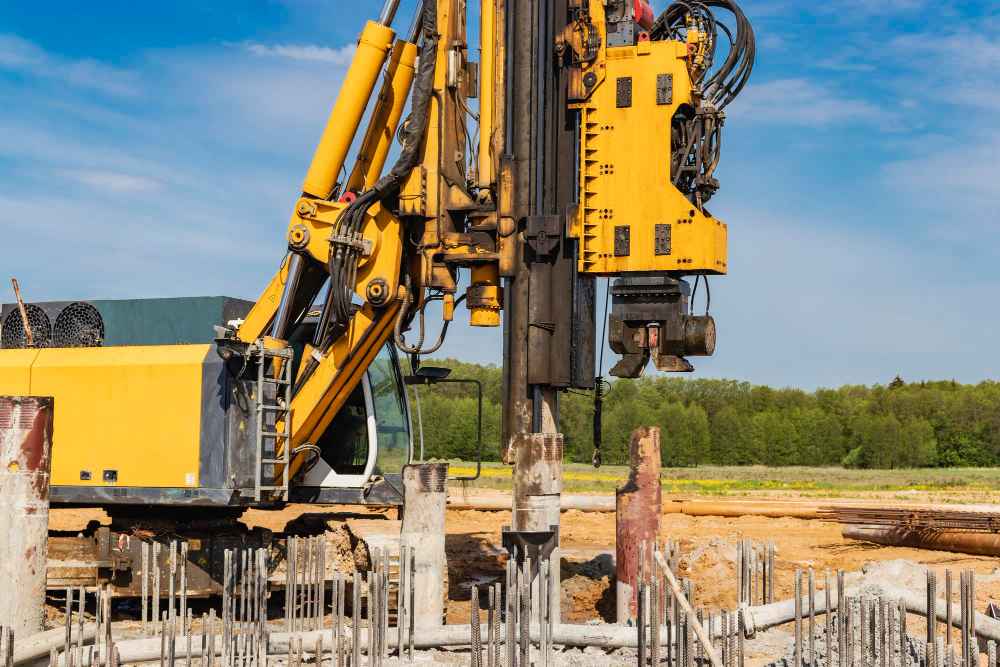
If you are constructing a building on soft or unstable soil, then making sure a steady foundation is important. A significant ground improvement technique is CMC (Controlled Modulus Column) piles, which play a crucial role.
CMC piles are organised in a grid network to distribute the superstructure’s heavy load effectively between the grid of CMCs and the ground. These piles have become popular over the past few years because of their productivity, economic efficiency, and eco-friendly impacts. They are frequently confused with other deep foundation techniques like drilled caissons or conventional auger-cast piles.
In this blog, you will discover what CMC piles are, how they work, and their evolving impact in construction.
How CMC Piles Work?
CMC piles improve the soil’s load-carrying capacity using rigid or semi-rigid columns. This process typically contains the following phases:
1. Installation with Minimal Displacement
For installing CMC piles with minimal invasion, a specially designed auger or drill is used, generally a hollow stem, in contrast to traditional piles that cause soil upheaval or vibration.
2. Column Formation
When the drill reaches the needed depth, concrete or grout is channeled through the hollow stem as the auger is progressively pulled out, producing a consistent column.
3. Controlled Stiffness
By adjusting the size and spacing of columns, professionals can control the soil’s modulus or rigidity, leading to a stable and maximised framework. This customised approach minimises complete settlement and makes sure that load is distributed evenly across the base.
4. Load Transfer to Soil Layers
CMC piles do not strictly need to reach hard rock. Rather, they are designed to support the soil by forming a network of columns that shift loads to steady soil layers, generally minimising the depth and expense of the foundation.
What are the Typical Applications for CMC Piles?
CMC piles are flexible and can be used in different building projects. Some of these applications are as follows:
1. Construction Projects
CMCs enable efficient installation and minimal disturbance to roads, railways, and airports.
2. Industrial and Commercial Buildings
CMCs are best for warehouses, workshops, and other huge structures that need a reliable foundation in wet soils.
3. Delicate Environmental Spots
CMCs are generally adapted for eco-friendly spaces such as wetlands or historic sites where low ecological impact is required.
4. Housing Developments
CMCs offer a cost-effective and efficient replacement for traditional methods for residential projects located in areas with tough site conditions.
Pros of Controlled Modulus Columns (CMC)
Some of the advantages of using the Controlled Modulus Columns process rather than piling are:
Time Savings
CMCs are a quick and efficient procedure for installation, and compaction minimises the construction period and speeds up project completion.
Cost Effectiveness
CMC is more resource-efficient and less time-consuming than traditional piling systems, leading to specific cost-effectiveness for construction projects.
Versatility
CMC may be utilised for diverse construction activities because it is suitable for several types of soil and environmental conditions.
Minimal Environmental Impact
CMC is eco-friendly as it preserves the ecosystem and minimises disturbance to the environment by reducing ground displacement.
Cons of Controlled Modulus Columns
Regardless of many benefits, CMCs also have significant disadvantages. Some of these are listed here:
Limited Use
CMCs are best for loose, soft clayey, or granular soils but cannot be used in stiff clays with high plasticity or in areas with a high groundwater level.
Long-Term Performance
While CMCs increase the load-carrying capacity of the soil, they may be burdened by continuous issues such as consolidation, settlement, and relative displacement when they are not accurately designed and checked.
Construction Constraints
The process of installing CMCs needs significant tools and qualified staff. They may not always be readily available, particularly in urban or distant areas where such supplies are in short supply.
Possibility of Failure
CMCs can never work well in specific conditions due to inappropriate settlement or faults in design. Some features such as inappropriate material selection, unsuccessful support, and unfavorable site conditions can result in disappointment.
Evolving Impact of CMC Piles in Construction
Through constant technical developments, CMC piles are improving productivity and accessibility. Their use can be increased with modern designs and upgraded installation tools, particularly when construction projects need cost efficiency and eco-friendliness. Incorporating sustainable resources and efficient deployment processes will further increase the ability of CMCs to perform in varied soil conditions.
Final Thoughts
CMC piles are transforming how foundations can be arranged on poor soil. These piles provide an economical, eco-friendly, and effective alternative to traditional piling procedures.
CMC piles combine soil improvement with a semi-rigid support system that helps ensure stability for different structures globally, from industrial buildings to residential developments. They may play an enhanced role in future builds as the construction industry keeps on advancing eco-friendly methods and compliance.